


Builders and BIM model. Interview with Gorka Gibert Alonso
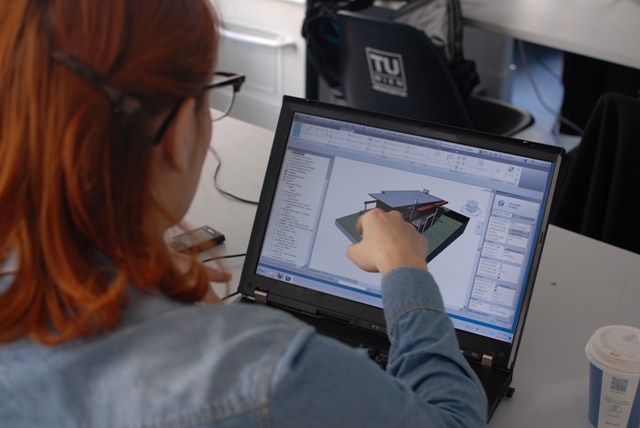
Despite its progressive consolidation in the sector, the truth is that there are still many construction companies that do not dare to take the step forward to incorporate the BIM model in their operation, believing that it may be unprofitable.
On thecontrary, the truth is that by working with BIM, construction companies can benefit from the advantages of an integrating model of the different processes of the construction project. Likewise, it is progressively being implemented as mandatory in public tenders
and private projects.We spoke with Gorka Gibert Alonso, teacher of the Guild and Director of BIM projects at Gesob, consultancy and management of projects and works, to tell us the news about BIM.
-In which projects is it already mandatory to use BIM?
Currently and since December 17, 2018 it is mandatory to use BIM methodology in all publicly funded projects in the construction sector. From July 26 of this year it will also be mandatory for public infrastructure projects
.-Does it require a large investment of time to learn how to use BIM? For which professional profiles will it be easier and for which more complicated?
The truth is that yes, you cannot learn BIM methodology with either a 30-hour course or a 60-hour course. The BIM methodology affects many aspects of our work, it is not only a work tool, it is a way of working that will make us modify our current processes, the tools with which we are accustomed and sometimes even the roles of our agents within the construction process. I think that all professional profiles have to change their process with similar difficulty, each with their new role. The most difficult thing to understand is that this new way of working must integrate all the agents of minute zero; project, construction and maintenance of a building must begin to work at the same time so that later it is much easier to arrive with the planned deadlines and
costs.-What is the profile of regular students in Guild courses? Builders?
In the courses that we teach at the Builders Guild we find all kinds of professional profiles, this variety gives a lot of play to carry out the classes because in this way we can explain the different way of seeing and using the same tool for the different profiles and what may interest one or the other more. I have had interior designers, installation engineers structural engineers, project architects, fitters and yes also builders, although to find us in the Builders Guild it must be said that in a lower number. There is a very logical reason, both public and private developers motivated by the advantages of using the BIM methodology already ask for their projects like this, but the potential that can be extracted in the construction phase and especially in the exploitation phase has not yet occurred. When the works begin to ask for experts with this methodology, the courses will be filled with builders
.-What would you recommend to our companies to adapt to BIM?
The first thing I would recommend is that managers believe in it, that they are aware that time and money must be invested to implement the methodology but that this investment will be recovered very soon with the first projects. You have to start by setting goals that are easily affordable and go up step by step with the rest.
Start with modeling courses to know the native tools of work, from where all the information comes from to manage the work I think is essential, perhaps many of the agents who will do the course will not dedicate themselves to modeling anything, but it is very necessary to know where the methodology begins.
-With Guild Revit courses what level is achieved in the use of Revit?
The Revit courses of the Builders Guild are very complete in the sense that the student takes a look at the possibilities of the program, but as we have talked about before, you cannot achieve a good level of the tool with a course of 62 hours in total. To be able to reach a high level of the tool you must do a minimum of 1000 hours to be an expert user. The courses serve us so that students can develop all these hours with practices in already defined projects or even the most decided ones with current projects.
-What's new about BIM in 2019? Trends?
The fact that already in mid-2019 the use of the methodology will be mandatory in all sectors of construction, it is expected that 2019 will be a year in which the projects carried out with BIM will increase exponentially. Unfortunately in many cases we only act when we are forced to do so, but also in others we realize the potential that this methodology has and the benefits it brings. The trend is that it is consolidated in the development of the project in BIM and that it is already beginning to be requested in a more general way on site, that the work processes are marked by a BIM objective to solve them and that not in the very distant future the construction cycle is finally completed and the operation of the building is part
of the process.