


Green roofs for an ecological Barcelona
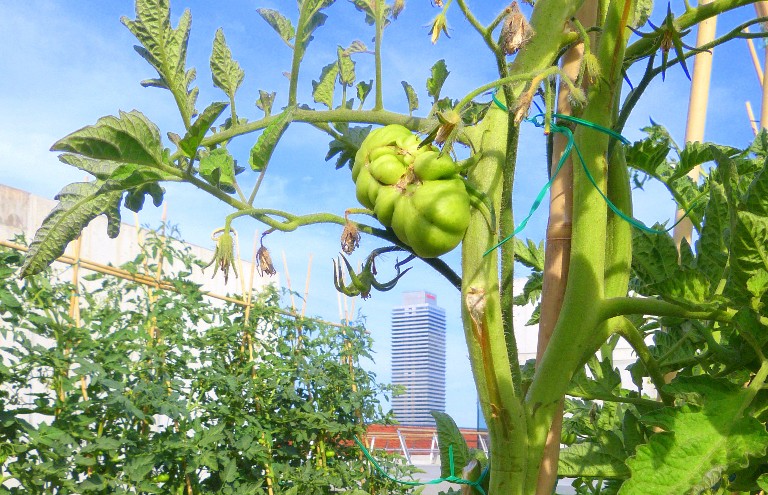
The federated company Eixverd is a pioneer in the installation of green roofs in the buildings of our city, defending that the quality of life can be significantly improved by creating gardens on the roofs and green community spaces.
By turning these empty and unused areas into sustainable environments, Eixverd advocates improving the value of a building, saving energy and changing the effects of increased pollution, urban density and climate change.
With this philosophy, one of the most interesting projects in Eixverd is the experimental roofs installed in the Ciutadella Campus building of the Pompeu Fabra University, which should allow us to study the best possibilities of roof installations on the roofs of our city. That is, to know which crops, materials and procedures are the best in terms of efficiency, sustainability and
convenience.In this sense, the project - which can be visited by contacting Eixverd or the Guild - consists of three experiments. We explain them below
.- Comparison of different green roof systems
It consists of the installation and study of the energy efficiency of thermally insulated planters from different manufacturers, with extensive sedum covers and semi-intensive covers. The different solutions are compared regarding their price, weight and water requirements, with the development of green and energy efficiency, in addition to the capacity to collect water and filter polluting materials from the atmosphere
.The first results have indicated that the presence of green roofs reduces the floor temperature of the cover by 9 to 12 degrees, with a greater difference in roofs with a greater thickness of substrate. Likewise, it has become clear that with good waterproofing with PVC or EPDM membrane there are no leaks or root penetrations. Green roofs provide a direct benefit to energy efficiency and contribute to a greater or lesser extent to the environment from the point of view of sustainable management of rainwater, absorption of Co2 and polluting materials, and improve urban biodiversity.
In addition to the collaboration of UPF, the Barcelona City Council, the Barcelona Metropolitan Area and the contribution of material by the manufacturers, this experiment is mainly carried out with the UPC (Polytechnic School of Building), and secondarily with ICTA-UAB (Institute of Environmental Sciences and Technologies of the UAB).
- More favorable conditions for growing lavender
The second experiment is a test of different building systems and different types of lavender. This test serves to validate the exploitation of lavender by aggregating the production of different roofs in Barcelona. Related to this experiment, a section of aromatic plants has also been developed
.- Best substrates for agricultural covers
The third operational experiment since March 2016 is a comparison of different substrates for agricultural roofs. Substrates for an agricultural cover have different characteristics from traditional garden substrate and substrate for cultivation tables. Drainage, water-saturated weight, stability or compactness, should be different than when the plants are directly in the ground or when the plants are on grow tables. One of the samples uses a construction system with a topsoil. The other uses another construction system and a technical substrate made from coconut fibers
.The results of the summer season indicated that a topsoil substrate has not performed as well due to the poor draining capacity. The most technical substrate based on coconut fiber has indicated that the production of tomatoes has been 3.5 times higher in thicknesses of 35cm compared to thicknesses of 25cm
.