


Lean Construction, or how to optimize the management of our works
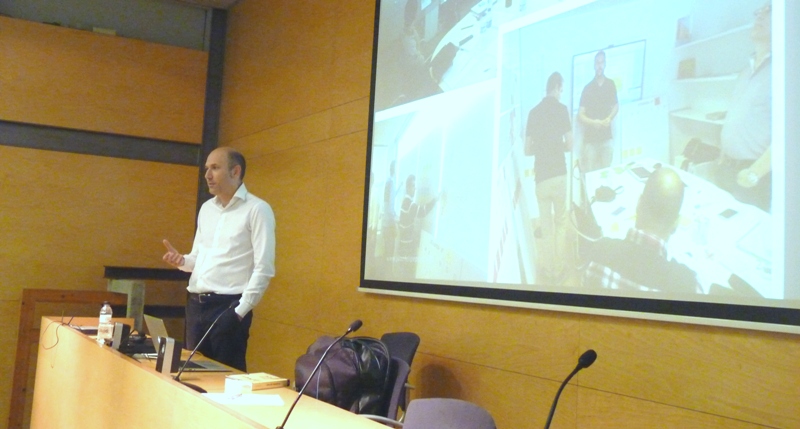
Last Wednesday, October 18, we held at the Guild headquarters a conference on Lean Construction, that is, the application of the Lean methodology in the world of construction. For the occasion, we had the presence of Juan Felipe Pons, specialist in Lean Management with extensive experience in the implementation of Lean in organizations of diverse sectors
.During his presentation, Juan Felipe Pons gave a broad overview of the current needs of the construction and project management business. At the beginning, Pons named some of the problems that usually lead to deficiencies in projects, such as lack of coordination, cost overruns or extended deadlines. The main problem faced by Lean Construction, in short, “is the lack of training in the sector and the use of obsolete work systems”. As he stated, “we believed that with the crisis the construction companies would take a step forward to modernize and optimize themselves, and the truth is that we have found that everything remains more or less the same in
terms of the operation of the projects, with the same problems to solve”.In this regard, two illustrative data were highlighted. According to a 2004 study by the Construction Industry Institute and the Lean Construction Institute, 57% of the time, effort and material investment in construction projects does not add value to the final product, compared to a figure of only 26% in the manufacturing industry. On the other hand, when measured, construction projects generally operate between 55 and 60% reliability in completing tasks the next day. In other words, construction today manages to finish just over half of what was planned 24 hours earlier.
Lean does not require any significant investment by the company, and can be implemented little by little Share on X Ina second part of the day, he went on to expose what Lean Construction is and what is its application in the sector, based on the philosophy of identifying deficiencies and finding solutions and methodologies to optimize processes and their costs. In this sense, Pons commented on different experiences lived in companies, where they managed to significantly improve processes through changes in work routines. Likewise, he highlighted as a difference from the implementation of systems in other areas, such as BIM, that “Lean does not require any significant investment by the company, and can be implemented little by little.
Regarding its implementation in Spain, he stressed that since 2010 great steps have been taken, with congresses, training actions and application to companies in different sectors, including construction. Among the associations of the sector that have been involved in the application of Lean, he named FLC, iTEC, ASPRIMA, CEN or the Guild itself. Likewise, “each country is applying Lean in different ways. In Spain, little by little it is gaining importance, and it does so in an atomized way”. Some of the countries where Lean has the most implantation would be the United States, Germany, the Netherlands or Peru
.Finally, the paper ended with a reflection on two interesting phrases from well-known theorists about organizations. The first is by Eliyahu M. Goldratt: “In business it doesn't matter how good you are, what matters is how good you are compared to the competition, and even if everyone is making the same mistake, if you are better than the other you will survive.” The second, by Peter Senge: “The ability to learn faster than your competition can become the only competitive advantage”
Later, the day closed with a turn of questions from the attendees.