


Maintenance work on the road roundabouts of Barcelona
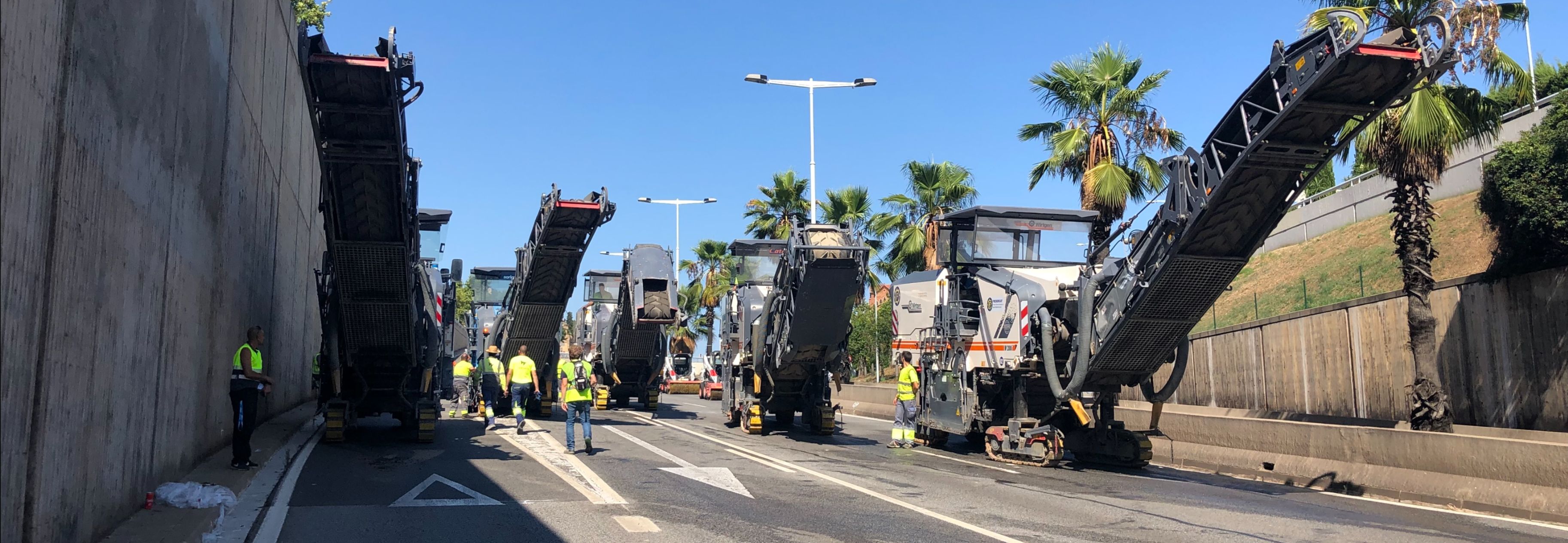
The Roundas de Barcelona is the road ring that goes around Barcelona and connects the municipalities of the Metropolitan Area and whose construction allowed Barcelona to transform into the Metropolis that we now know. This road, which began to be planned in 1963 and which was inaugurated in 1992, allowed to decongest the main arteries that entered the city and with it began the pacification of traffic for which we still work today.
Although regional strategic planning seeks a more transversal model of Calle Mayor style, the implementation of this change is far from our reality. At the moment, the Roundabouts are still roads on which all types of vehicles can circulate and are located outside the Low Emission Zone (ZBE
In this way, our task remains to guarantee its original function of transport and communication between the people of Barcelona and its Metropolitan Area. For this we have a team of more than 30 field workers and 11 technicians specialized in maintenance and operation of roads. Whether during the day or at night, all of them make every effort to ensure the safety and facilitate the mobility of Ronda users
.Although in most cases their work is imperceptible, the performances of our staff become the focus of attention of the Metropolitan Area twice a year. This happens during Holy Week for the one known within our team as the asphalt procession and in summer as the asphalt exodus. We refer, of course, to pavement maintenance works that require total interruption of traffic for more than 24 hours. Due to the great impact on traffic, such works can be carried out only when the influx of vehicles is lower, which happens when most of our neighbors leave the city and go on vacation.
Unfortunately, the COVID-19 pandemic has prevented the planned action for this Holy Week from being carried out. So, just as the Primavera Sound is postponed, we postpone this procession to August knowing that as long as our neighbors enjoy their sea views we will do it from the Besós River.
Although during the state of emergency we lost the opportunity to hold the annual Easter macro-performance, the various round teams do not stop their invisible work given their essential service character. Recall that the Barcelona Rounds are the fastest way for the circulation of the different emergency equipment such as firefighters and ambulances, they allow access to all the hospitals in the city and guarantee access to basic supplies
To achieve this, our surveillance and road assistance teams are active 24/7 365 days, attend to an average of 3 incidents a day and cover more than 115,000 km per year (it would be like circling the earth more than three times around the equator). We equip our teams with two GPS devices per vehicle, on-board cameras, waypoint control system, connection to the Ingrid web system via Tablet by the guards and continuous communication with the control center to guarantee assistance to the road user and our staff
.It is the facilities maintenance team that guarantee the correct lighting of the tracks, the perfect condition of the pumping wells, the optimal ventilation in the tunnels, the maintenance of emergency systems such as SOS poles, fire extinguishers and communication systems as well as many other elements that as users we do not perceive but that are basic to guarantee our safe driving and help us in case of emergency.
Among the most visual activities we can identify that of our mowing brigade that maintains approximately 2 million m2 /year, the equivalent of a daily football field. This activity that minimally affects traffic is usually done during the day and not only makes the area visually pleasant but also guarantees the visibility of the road, its signage and
adjacent elements.We also have the civil works maintenance team dedicated to guaranteeing road safety either by replacing containment barriers and protection skirts for motorists hit by accidents, improving vertical and horizontal signage, waterproofing structures, improving joints in viaducts, sealing cracks in roadways.
We will not forget either the road cleaning crew with a mechanical sweeper that at the end of the year covers a total of 5,387 km only within that ring of 40 km that are the rounds. Their tasks are not limited to sweeping the roadway, they also clean the different drainage elements. In parallel in the contract there is the tunnel cleaning equipment intended for the cleaning of gables and the soot adhering to the roofs of the tunnels. Thus, we not only improve air quality but also improve its indoor visibility. These works of cleaning walls and roofs are carried out by applying a biodegradable detergent and then rinsed with a specifically designed truck that applies water at a pressure between 180-230 bar. Again an almost invisible job since given the complexity and impact on traffic these are carried out at night.
Although each team performs different tasks, they all have in common the recurring need to cut the road. In total, more than 2 rail cuts are made daily through the placement of provisional site signage and cones. The high risk of this action therefore requires the collaboration of all parties:
First of all, both rapid lane cuts and total cuts require the support of law enforcement authorities. In particular, we must thank the Guàrdia Urbana de Barcelona and Mossos d'Esquadra for the beacons through their vehicles improving our shield vehicle and protecting our workers, their tasks of pacifying traffic and the reinforcement they do of citizen information tasks
.Secondly, the involvement of Rounds users. They are informed of the performance from the alphanumeric panels distributed along the entire trace in which apart from informing about the area of works, the presence of people working for them is also emphasized. If we add to this that we have arranged every night a speedometer car at the beginning of the cut that indicates to the user his real speed, the notice and information of the entrance to the works area is total
.Last but not least, most of the efforts to prevent risks are implemented by us.
-We started with the sectorization of the B 10 by placing book-type signs at all accesses that avoid manual handling of loads and limit the exposure of our operators to the risk of running over.
-Improvement of our PPE using high-visibility class III clothing that guarantees the recognition of the human figure in 360° and highlights its limbs, if we add to this that each worker is equipped with a front (front lighting and rear beacons) placed on the helmet, it makes it easier for the driver to identify that the operator is facing or behind the traffic.
To conclude the maintenance contract, we have designed, developed and put into operation our own vehicle for carrying out approved lane cuts. This vehicle ensures that the team works in coordination as it facilitates visual and acoustic contact between operators. Acoustic cameras and beacons located in the vehicle body and connecting to the cab of the mower truck allow better communication between them. Workers who are inside the vehicle body delivering the cones are correctly attached to the vehicle structure and use rotating carabiners to facilitate their movement. For its part, the worker who places the cones does so sitting on an ergonomic and rotating seat that facilitates the movement of placing the cones and that can be adjusted to their particular anatomy.
In short, with the preventive contributions developed in the last three years we have achieved a triple objective: the direct participation of external agents, involving and sensitizing road users, and improving working conditions in the development of our daily tasks, minimizing the time of exposure to traffic, falls at different levels and reducing the degree of stress.
Apart from all of the above, internally we have also concentrated efforts on the protocolization of the various recurring tasks as well as on the training and information of all the work divisions. For example, in the line of civil protection and emergencies, last 2019 we trained 100% of our team both in first aid techniques and in the handling of the defibrillator and included in our maintenance center and our road vehicles an automatic external defibrillator (AED). In this way the Rounds can be considered, in addition to a safe road space, a protected cardio place
. TheRondas team would like that when we can go out again to enjoy our roads you will remember these human teams that never stopped working so that day and night, holidays and weekdays, confined or not, you can circulate safely and enjoy the journey. Remember that on the road you are never alone and your road safety is our job security.
Teresa Mª Cano Rodriguez
Safety and Health Coordinator
E-Scentia
Javier Calvo Rivera
Head of Works
UTE CONSERVACIO ROUNDS
SORIGE COMSA