


What did we talk about at RiME on July 18?
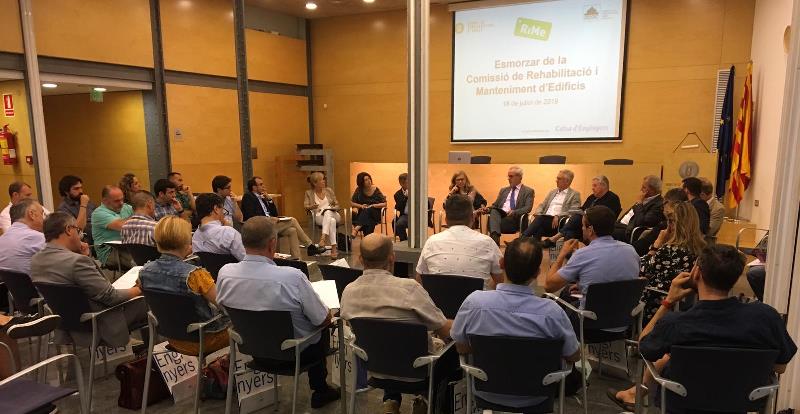
Last Thursday, July 18, the Guild's headquarters hosted a special session of the RiME Commission, with the presence and participation of property managers, convened by the College of Property Administrators of Barcelona and Lleida. The intention of the day was to bring together property managers and builders, in order to foster an enriching debate for both parties; and so it was
.The conference, moderated by the president of the Guild, Josep Gassiot, and sponsored by Caixa d'Enginyers, was divided into three themes: Technical Inspections of Buildings, budgets and works contracts.
Technical inspections of buildings.
The first part of the meeting was aimed at discussing ITE, answering questions such as: Is ITE enough to start a rehabilitation? How to manage an unfavorable ITE? What are the responsibilities of each of the agents involved?
In addition, it was pointed out that many communities of owners, mistakenly, do not have a clear idea of what the ITE is, or what it is for. In this sense, it was recalled that the ITE is only a diagnosis of the state of the building, and not a rehabilitation project, which will be what the technician will subsequently have to do taking into account the prescriptions of the ITE
.It was agreed that the large increase in ITEs produced in recent years is positive.
Budgets for rehabilitation projects
A second theme was the presentation of budgets for rehabilitation projects by construction companies. It is common for some communities of owners to ask the builders for estimates before the preparation of the report and project by a competent technician.
On the contrary, it was agreed that construction companies should submit the budget once a technician has drawn up a project. In addition, and in order to standardize contracting and promote good practices in terms of legal responsibility and process optimization, the possibility of incorporating specifications defining the conditions that companies must meet when tendering a work is defended
.This would allow the builders to be clear from the beginning what are the minimums required by the community, and therefore, to better adjust the budget to the project that will occur later.
The problems represented by budget increases in the course of the works were highlighted, which are avoidable through good coordination of the community of owners, technicians, administrators and builders; and the establishment of appropriate procedures that optimize the budget selection processes.
He also defended the desirability of each community of owners not only having a property manager, but also a trusted technician who can be consulted whenever necessary, and who can complement the estate administrator when giving recommendations in relation to the building.
In addition, the usefulness of the Consta accreditation to ensure the responsibility of construction companies was also highlighted.
Contracts of works
The last central aspect of the day, the works contracts, agreed on the need to standardize contracts, which are simple and flat. It also defended the inclusion of a penalty clause, which can resolve conflicts without entering into litigation.
Likewise, emphasis was placed on the desirability of always drawing up “serious” contracts, which serve as a model for the management of the work. In relation to subcontracting, the need to register the different subcontracts with the utmost transparency and responsibility, in compliance with the legal conditions, was stressed
.