


What did we talk about at the RiME on October 10?
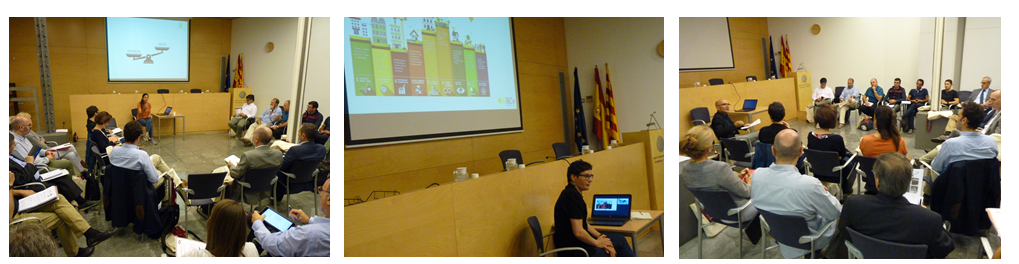
Health in buildings was the focus of the last RiME Commission, held at the Guild's headquarters on the morning of Thursday 10 October.
The session, moderated by Josep A. Martínez, president of RiME and vice president of the Guild, was sponsored by the company Predecat —you can find information about its decorative concrete prefabricated on its website-, and featured presentations by Eulàlia Figuerola, architect and delegate of the Green Building Council; and Sonia Hernández, architect and founder of the Arquitectura Sana studio
.Health in the building, Eulàlia Figuerola
An expert in sustainability and energy efficiency, Eulàlia Figuerola explained the objectives and actions of the Green Building Council Spain (GBcE), an organization of which she is a delegate and which brings together representatives of all the agents of the building sector in order to contribute to the transformation of the market towards a more sustainable and healthy building.
One of the objectives of this entity, therefore, is to defend the need to value the effects on the health of the elements of the building. “We are concerned about eating well, playing sports or air quality, but on the other hand we still do not take much into account the importance of buildability in our body, even though we spend most of our time inside buildings,” Figuerola
said.As mentioned, the lack of indicators and awareness means that the health effects of buildability are still underestimated by owners, companies and administration. That is why the GBCe is focusing on identifying indicators and solutions to improve the healthiness of buildings, taking into account how, for example, optimal natural ventilation can reduce lung diseases by up to 20% or how the discharges of workers when they receive natural light and have access to external views are reduced by 6.5% and their productivity can increase about 15%
.These and other effects, as well as initiatives and indicators driven by the GbCE, can be found in the power point presentation that we attach below:
Architecture and Health, Sonia Hernández
In turn, Sonia Hernández, architect expert in bioconstruction and healthy spaces and founder of the Arquitectura Sana study, explained how the Generalitat has promoted in recent years the PINSAP, Interdepartmental and Intersectoral Plan for Public Health, to implement the study of the effects on health from the different social areas, including also architecture and urban planning, through biological factors chemical, physical, moisture, electroclimatic, lighting or electrical.
As Hernández has defended, issues often neglected such as the correct installation of earth dams or adequate ventilation are fundamental to the quality of life of citizens, and are increasingly being considered by administrations, owners and companies. A paradigmatic example would be the detection and treatment of radon gas, which, having demonstrated its carcinogenic effect, is already a matter dealt with in those areas with the greatest impact of this gas, and it is expected that specific measures to reduce its impact will soon be legislatively required.
It would therefore be a question, according to Hernández, of continuing to identify which parameters are least harmful to us and of applying protocols and measures, either by introducing them legislatively as well as by creating demand from consumers, by disseminating the advantages of living in healthy buildings.
You can find more information in the power point presentation that we attach below:
Discussion with attendees
After the presentations, the conference had a debate between speakers and attendees, among whom were mostly construction companies, but also representatives of other entities in the sector such as the Col.legi d'Arquitectes de Catalunya, the College of Property Administrators of Barcelona and Lleida and the College of Aparelladors of Barcelona.
Among the attendees, it was highlighted that a lot of pedagogy is still needed to make society understand the need to invest in health also in buildings, as is already done in the supermarket or when buying a car. In this sense, the promotion of these measures by the administration was also considered essential, as well as the need to draw up protocols and checklists to facilitate the work of builders and owners in relation to the factors to be taken into account and how to treat them.
It is noteworthy that the Col.legi d'Arquitectes de Catalunya is already preparing documentation of this type, which will be sent to us to the Guild and which we will also send to the affiliated companies as soon as we have it, so that you can use it on the works and with the owners and promoters.
Miscellaneous matters
A last blog of the day served to make a brief mention of different current topics. The UPC Diagnosis Project was named, which aims to promote and improve diagnoses in buildings and of which we will detail more information as it develops.
They also commented on the day that will be held at the Guild on Tuesday, October 22, and which will feature the heads of commercial operations of the Catalunya Oest and Catalunya Est Network of the electricity company ENDESA. The conference will aim to resolve doubts about the installation and management of new supplies in buildings. You can find more information at the following link:
-Matchday 22/10. INSTALLATION OF NEW SUPPLIES IN BUILDINGS
The day ended, as is tradition, with a breakfast on the right foot.