


Wood takes over Barcelona
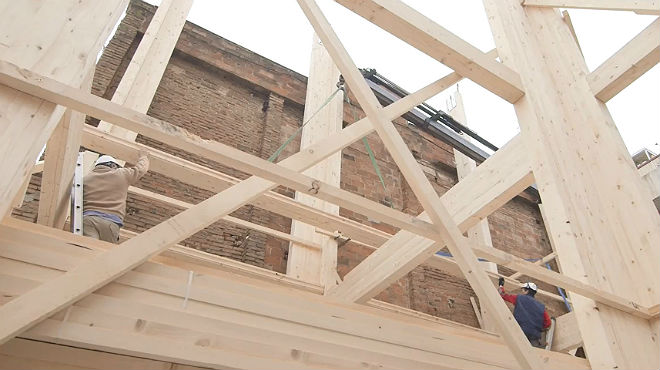
Contrary to the metallic and huge buildings of science fiction films, everything points to an old acquaintance, wood, will be the protagonist in the urban landscapes of the future... even in the form of skyscrapers.
In fact, there are already wooden skyscrapers, such as the Forgemind Archimedia, which at 29.5 meters high and eight floors is the tallest building in North America. Much more extraordinary would be the 300-meter skyscraper presented by a team of architects from the University of Cambridge last April in the city of London. Still in the study phase, its creators define it as “a sample of what construction will be like in this 21st century
”.In Barcelona, despite the scarce use we give to wood as a building material, the truth is that in recent months a handful of innovative projects have been developed that reconcile the use of wood with the city.
In just one year, a building of tourist flats has been completed in Poble-sec, a municipal facility (Can Portabella), a single-family house of five floors in Gràcia and three other projects underway: a four-apartment building in Sants, the housing cooperative La Borda on municipal land of 28 floors and 46 social flats built on the industrial site of the former Fabra i Coats, in the district of Sant Andreu.
From the Guild we had the opportunity to make guided visits to the multi-family house on Carrer Melcior de Palau and to the single-family house of Gràcia, the tallest wooden building in Barcelona. In both visits we verified the commitment of these innovative constructions to energy efficiency, sustainability and the health of its inhabitants.
In general, this generation of wooden houses that are coming to Barcelona are the result of a desire to optimize the construction model, using wood and the different energy efficiency systems to achieve better insulation and comfort benefits.
Likewise, some builders highlight how these houses, which usually combine wood with the concrete of the foundations of the building, are faster and less energetically expensive to build, although due to the set of innovations they incorporate are at least 10% more expensive than concrete constructions.